Locations in Hungary: Mid-century Architecture of Lake Balaton
zita kisgergely
Lake Balaton is a significant geographical and cultural feature of Hungarian life. As a popular holiday destination, the architecture of the region reflects several different epochs. But as the infrastructure began to develop rapidly from the 1950s, so too did the construction of restaurants and hotels representing a modern, socialist-era building style that was predominant until the late 1980s.
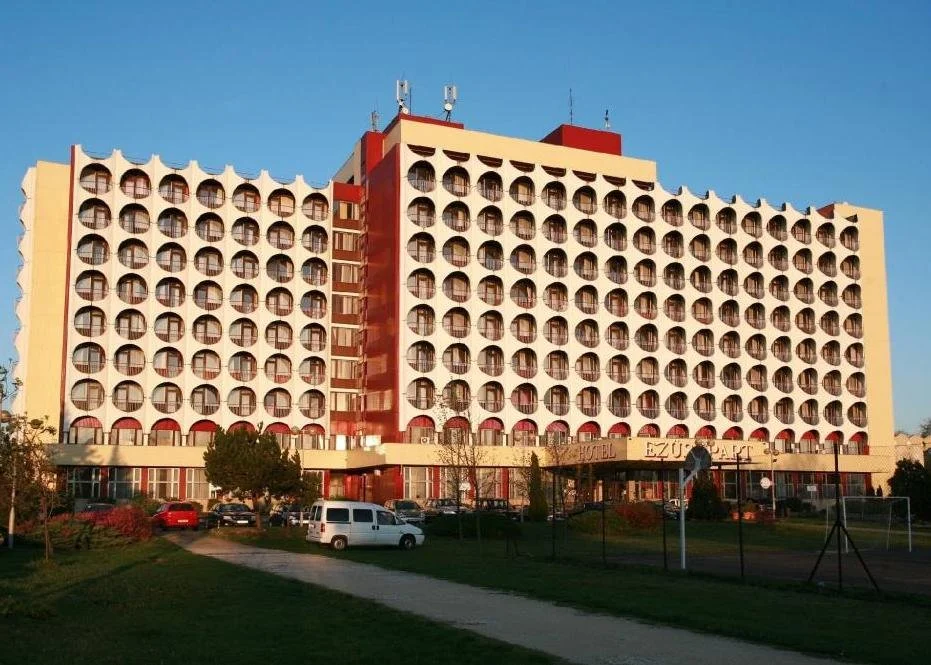
Ezüstpart Hotel, Siófok, Lake Balaton. Photo via startutazas.hu
The story of how infrastructural development was fast-tracked after 1956.
The area began to be more seriously developed after the 1956 revolution. Eager to “depoliticize” the masses, the central authority pushed for holidays to be attainable for everyone. Getaways to Balaton seemed just the ticket, but infrastructure in the form of roads, motorways, accommodation, beach areas and restaurants needed to be established fast.
A unified, regional plan was required and commissioned, with a team of three people formed to oversee projects. By the late 1950s, construction was begun. Primarily focussing on public utilities, footpaths and holiday accommodation, infrastructure surrounding beach areas were also developed, including parks, shops, food stands and restaurants.
Why did Balaton develop differently from other Eastern European holiday resorts?
The small Balaton team assessed an average of 100 building permits per week. Most plans (not including public institutions) were then executed by local tradespeople, which resulted in wildly different quality standards. But with this number of projects happening simultaneously, there was no possibility to properly devote time to each. Understanding the circumstances of the time helps to explains how some of the architecture and infrastructure of the area came to be–the good and the bad.
Károly Polónyi, who would go on to write a memoir about his experiences of the time, was one of the three people on this team. He became Chief Engineer responsible for the development of the southern shore. In his memoir, Polónyi explains that during his three-year tenure he was able to access a company motorbike as well as the network of MÁV trains to travel, sleeping under a tent pitched on a boat moored at the Balatonföldvár yacht club from Spring until November. In his memoir, Polonyi comments:
“By submitting the Balaton Regional Draft Plan, we managed to dissuade the government from creating a holiday resort similar to the Romanian resorts by the Black Sea and the Bulgarian Gold Coast, where tourists from the west can spend their foreign currency in an area separated from the local community. Instead, we set out to reform the region as a whole, as a living organism with carefully selected investments. Our main aim was to create infrastructural investments that everyone could benefit from, including locals, holidaymakers, tourists, Hungarians and foreigners.”
Some architectural highlights of the 1960s-1980s around Lake Balaton.
A recent article in Telex written by Péter Sz. Németh and János Fehér reflected on just over 40 years of architecture around Lake Balaton. Not everything built during this era can be written off as sprawling socialist monstrosities. Using the book Balaton Modern 1956 – 1989 published by Kedves László Könyvműhely and Domonkos Wettstein (with photographs by János Bődey) as a kind of guidebook to the area, the writers of the article found that there are many structures that incorporated traditional building materials to create something practical that still blended into the surrounding area.
As one of the more prominent resort towns on the southern shore of the lake, Siófok had its fill of company and trade union holiday resorts springing up from the 1970s. Usually bulky hotels built to accommodate hundreds of staff and their families via subsidized holidays, they were designed with convenience and efficiency top of mind.
Hotel Ezüstpart: (photo above) Created by the Ybl prize winning architect Erno Tillai, the hotel was finished at the beginning of the 1980s. This memorable-looking structure in Balatonszéplak with a lattice-like façade curving around room balconies includes 354 rooms and a large inside pool complex. It was the last hotel to be built under the scope of the regional development plan that began in the 1950s.
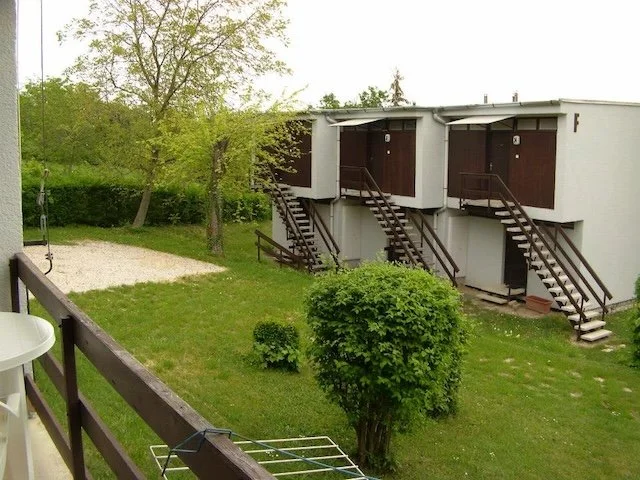
BMW Holiday Apartments (via their facebook page)
BMW Club Holiday Apartments: Not all these structures involved large complexes such as the Ezüstpart Hotel. Co-op holiday resorts were also designed to create a more secluded experience, such as this development of row-houses designed by Zsolt Bajnay, another Chief Engineer with the Balaton Executive Committee.
Built in 1968, each of the 42 units (although only 35 square metres in size) nevertheless contain sleeping alcoves for up to four people and a private bathroom. In total 160-170 people could be accommodated at a time.
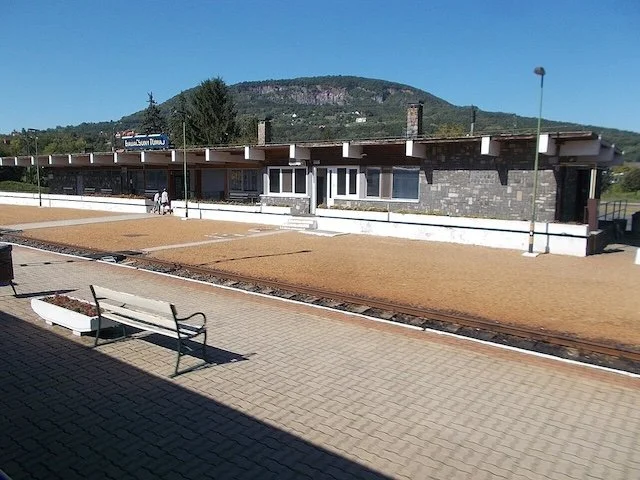
Badacsonytomaj railway. Photo via Wikimedia
Badacsonytomaj Railway Station: Built in 1971, this small station, a brutalist-inspired rectangular building with a flat roof comprised of wooden planks, is big in scope. Thanks to the quarry that once operated in Badacsonytomaj, basalt stone was used to tile the station’s walls.
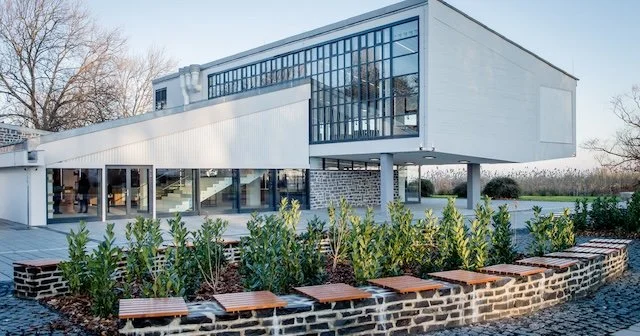
Tátika Restaurant. Photo via EBH Invest.
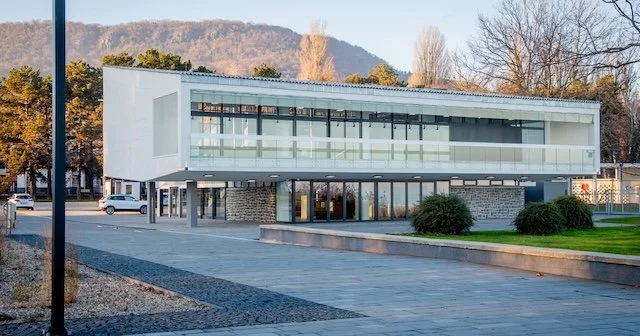
Tátika Restaurant. Photo via EBH Invest.
Tátika Restaurant, Badacsony: The Tátika restaurant, designed by Ference Callmeyer and built in 1962, was originally planned to hover five metres over the surface of the lake. However, the area was later paved as the often-icy waters in winter deteriorated the structure. Declared a heritage building over fifteen years ago, the restaurant has recently been extensively renovated and the interior completely modernized. It currently functions as both a restaurant and tourist information centre.
Sources & further information
Flatpack Films has years of experience servicing international brands, agencies, and production companies. Filming in Hungary is easy when relying on their knowledge of the market and ability to solve complex needs. They bring the best that Hungary has to offer in terms of unique locations, exceptionally skilled crews, top-of-the-line equipment and technical solutions. Backed by an impeccable track record, Flatpack Films has worked with world-class clients including Samsung, Samsonite, Toyota, Braun, Chivas Regal and many more.
Get in touch and learn more about Budapest film locations, Hungarian film incentives, film tax credits in Hungary and how Flatpack Films can bring your project to life through a highly bespoke approach.